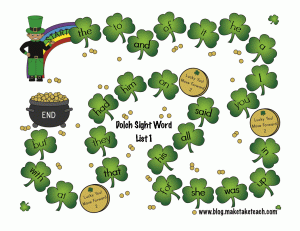
Home Depot, Michael’s and the Dollar Tree are my three favorite stores when looking for ideas for creating teaching activities. During any holiday, Michael’s Craft Store has oodles of fun items that can add a little holiday spirit into your small group activities. While perusing the St. Patrick’s Day section, I found these adorable plastic shamrock gems, plastic gold coins and mini-leprechan hats. Instead of using the plastic counting tiles or blocks during phoneme segmentation activities, try using one of one these items. The gems and coins can be used instead of the tiles on the downloadable “Squaring Up” activity cards and students can simply move a hat for each sound in a given word.
The Squaring Up activity is available in my TpT store. When you download this activity, you’ll receive 44 colorful squaring up cards!
Click HERE to download this activity.
Have a Happy St. Patrick’s Day.
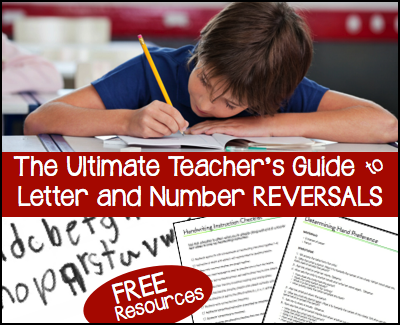
One of the great benefits of my job is that I have the privilege of working with many skilled professionals from various disciplines. We have a dynamite staff of Occupational Therapists who are never short of ideas and suggestions. I recently had a discussion with one of our OTs, Lyzz, regarding letter reversals and handwriting in general. Lyzz said that if students space between words and use correct letter size differentiation (using tall, short and below the line letters) that despite spelling errors, you can typically read and understand what was written. Although there are several strategies that can be used to teach and remind students to space between words, Lyzz’s preferred method is the one which includes using small stickers. She likes this method best because it doesn’t take the student “out of the writing process” such as what happens when using a stick or clothespin after writing each word. The sticker strategy goes something like this:
1. The student is told that the spaces between words must be wide enough to fit a small sticker. Small smiley face stickers work best. These stickers can be found in the teacher supply area in office supply stores such as Office Max or Staples. Smiley face stickers are made by SmileMakers.
2. A visual reminder is placed on the student’s desk during the writing process which shows a small sticker placed between the words.
3. After the student finishes his/her writing, the paper is given to the teacher and a small sticker is placed between words where the sticker will fit. If the space between the words is too small, a sticker is not put in that area.
4. A reward system can be used. For example, when the student reaches a predetermined amount of stickers, a reward is earned.
Student Word Spacing Reminder Strips
Click the above link to download a free pdf of student reminders for their desk.
Of course not all students in your classroom will need this intervention. Use this strategy for only those who have difficulty with word spacing. Once the student is consistently spacing between words, the intervention can be faded to occasionally placing stickers between words on writing samples (e.g. once a week).
Another common writing issue in the early grades is students not using their non-writing hand to stabilize their paper. Here’s a cute and effective strategy to help. For students who write with their right hand, place a visual of a handprint in the left hand corner of the paper and instruct the student to place their non-writing hand over it. Lyzz likes to use the “Squishy Prints” handprint which is commerically available through Abilitations. Typically, using this strategy for about two weeks resolves the issue.
Occupational Therapists are great resources for ideas and strategies to help our beginning writers develop strong writing habits early on. Thanks, Lyzz, for your contribution to this blog!
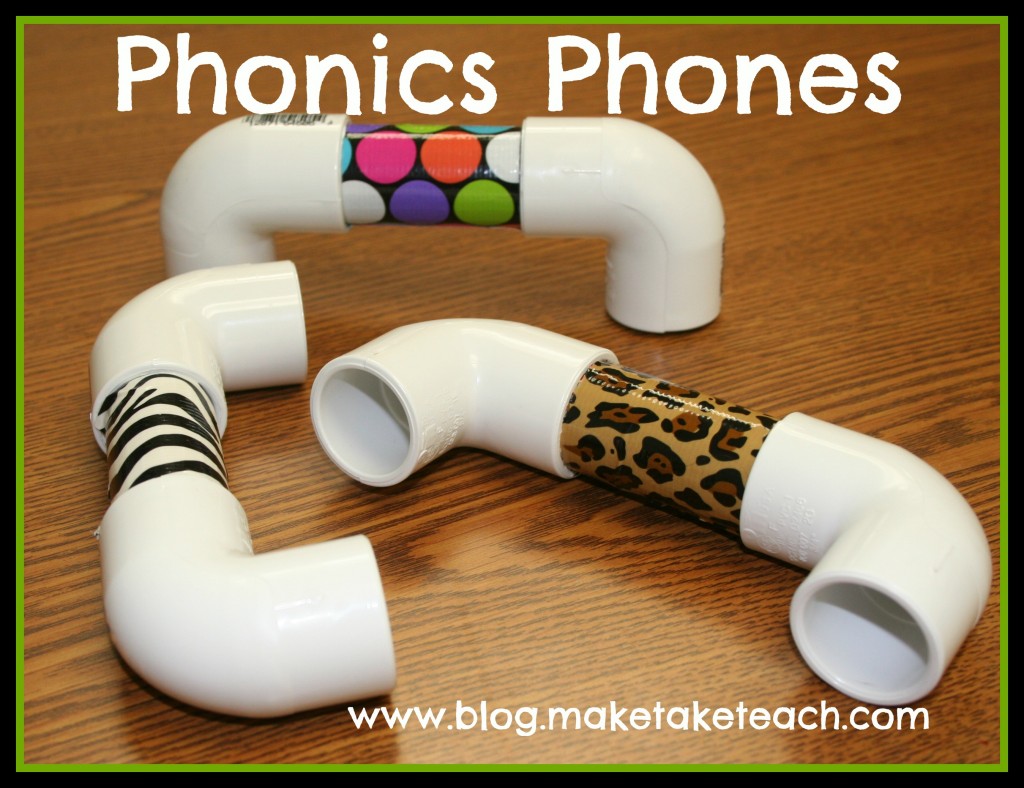
Phonics phones and mirrors are two of the most important items in an early elementary small group instructional area. Phonics phones amplify the student’s voice helping the student to focus and pay attention to the sounds. Although you can purchase phonics phones, they are quite easy and inexpensive to make. View the video for instructions on how to make your own classroom phonics phones.
To make phonics phones
Use phonics phones…
1. when teaching phonemic awareness skills.
2. when teaching letter sounds.
3. when teaching students to discriminate between similar sounding letter sounds. Take a look at your students’ writing samples. Phonics phones can be very helpful with students who confuse letters such as f/v, s/z , or sh/ch.
4. when working with students who omit letters in their writing. These students may not be paying attention to each sound in the word.
5. during guided reading activities. Some teachers find that giving each student a phonics phone while reading text a loud to themselves helpful.
Helpful Hint: Especially in first grade, students should have their own phonics phone which is accessible as needed during writing and spelling activities. If students are sharing phonics phones in your small group area, be sure to have antibacterial wipes on hand.
Click HERE to download free key word flash cards. These cards can be used with the phonics phones to teach letter sounds. You may also like my Tee It Up For Sounds cards.
Last summer I read Malcolm Gladwell’s book The Outliers. I haven’t read a good non-teaching type book in a long time. Although I call it a “non-teaching” type book, the ideas presented in the book shaped my thoughts of teaching and learning more than any other book I’ve read. The concept behind the book was to look at lives of extraodinarily successful people and the circumstances and conditions which lead to their success. There are many ingredients that lead to success, but the one concept that stood out as I read the book was that of the 10,000 hour rule. Gladwell said that in order to truly master a skill, whether it’s in athletics, music or a skill such as computer programming, a person must practice that skill for 10,000 hours! Putting in the hours, however, is not good enough. How you practice is equally as important as how much you practice. Practice must be deliberate. This means as you practice your skill, there is a concerted effort to improve by increasing the difficulty in gradual steps and repeating the skills to perfection.
How does this apply to teaching children to read, and specificially, how children master a specific skill such as learning their short vowel sounds? Well, obviously, if we want children to be strong readers, they need to practice reading, and practice reading A LOT! They also need to practice skills deliberately. Students need to “perfectly practice” the foundational skills essential to reading. Learning the correct vowel sounds is challenging for many young readers. So, how do we have our students “perfectly practice” short vowel sounds?
1. First, be sure you are teaching the correct sound for each vowel. Sounds simple, but several of the vowels sound very similar and this can be tricky. If you have volunteers working with your students, be sure they are also teaching the correct letter sounds. Visit the “Learn“ section of this blog and view the Teaching Short Vowels video to learn the correct pronunciation of the short vowel sounds.
2. Use picture cues and key words to cue the correct vowel sound. Picture cues can be placed in the classroom and on the student’s desks.
Click HERE to download free key word picture cues to use in your classroom and for individual students.
3. Use hand signals for each vowel sound. More than any other strategy, I find teaching hand signals to be highly effective in having the students learn the correct sound. This way students are immediately cued into the correct pronunciation of the vowel sound. The Teaching Short Vowels video under the “Learn” tab shows commonly used hand signals for each vowel.
4. Provide frequent opportunities for students to practice short vowel sounds. “Vowel Intensives” is a strategy that I learned during my Phonics First training and find very helpful in teaching short vowel sounds. Using this strategy, students are given vowel sticks with either the key word or the letter and are required to hold up the correct vowel stick when the teacher provides the vowel sound. You can differentiate the activity by deciding which vowels to work with, how many vowels and by either providing just the vowel sound or a CVC word.
Click HERE to download the free pictures and letters to create your own vowel sticks. Also try the Clip The Short Vowel activity.
Okay, I suppose 10,000 hours of short vowel practice is a bit overkill, but point well taken. Frequent and deliberate practice is key!
“Practice does not make perfect. Only perfect practice makes perfect” — Vince Lombardi
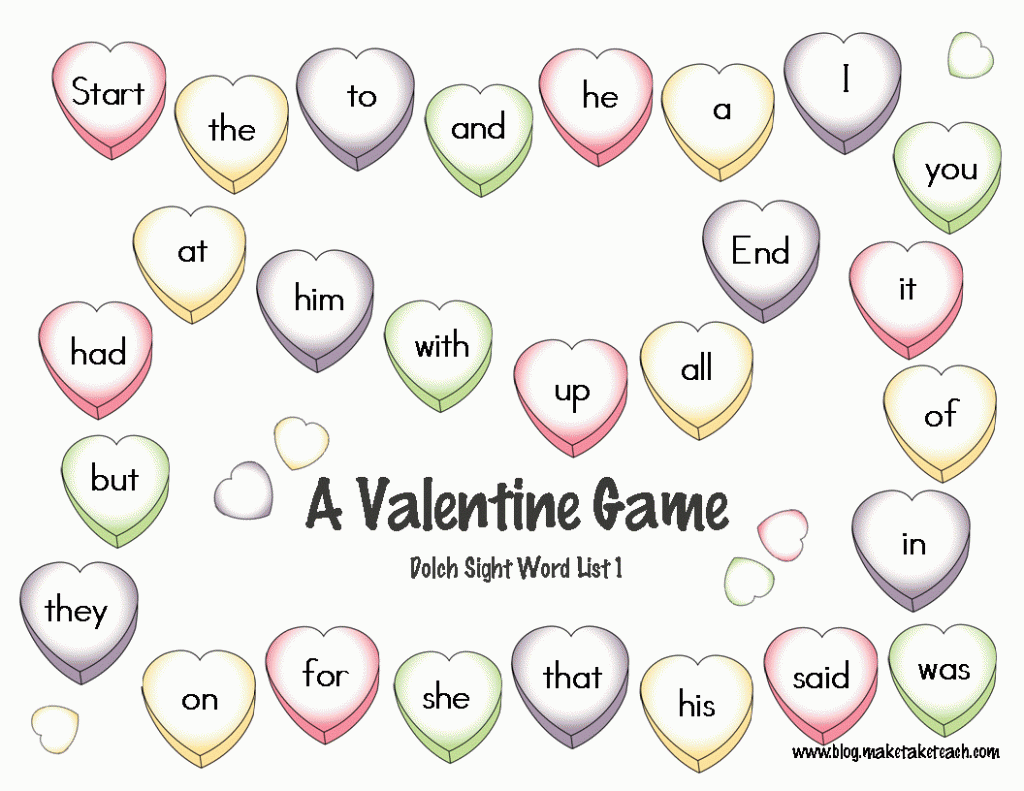
I love Valentine’s Day and I love making activities. So I REALLY love making Valentine’s Day activities. These holiday sight word games can be used either in literacy centers or for your small group intervention. Be sure to differentiate by using your mid-year sight word assessment data to determine which sight word board would best meet the needs of your students. There are seven game boards. Six of the game boards contain words from the Dolch Sight Word Lists 1-6. A blank board is included so that you can add your own words. Have a Happy Valentine’s Day!
Click the picture above or HERE to download your free activity.
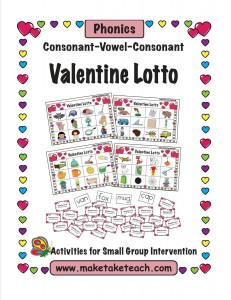
My other Valentine’s Day activities:
Valentine Beginning Sound Match