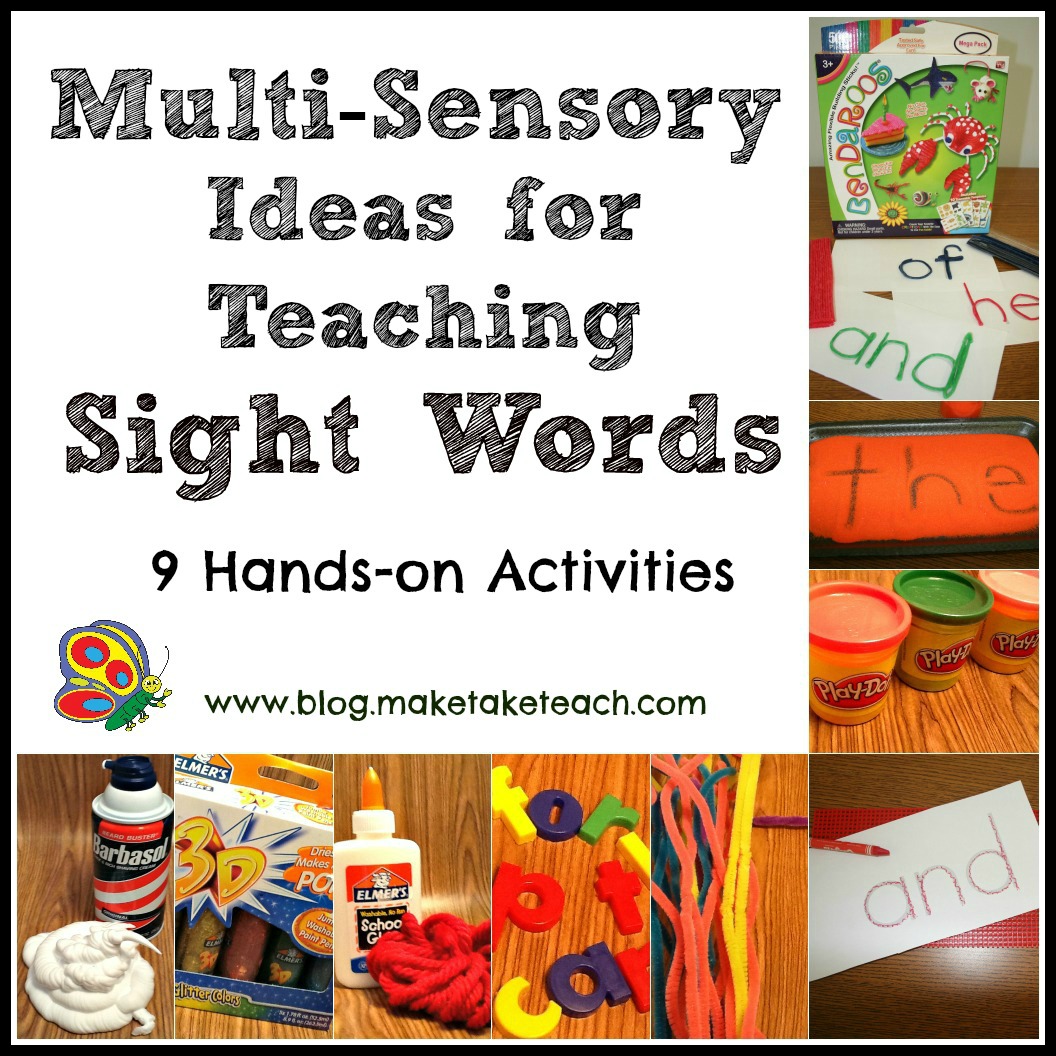
Multi-Sensory Ideas for Teaching Sight Words

In order to be fluent readers, students need to be able to recognize sight words quickly and accurately as these words make up between 50-70% of the words we encounter in text.  Students who struggle learning sight words greatly benefit from using a multi-sensory approach to teaching.  The term “multi-sensory” means using all the different senses at the same time.  Using this approach to teaching increases the likihood that the student will remember the word.  When teaching sight words this coming year, try using a variety of multi-sensory materials during your small group intervention or within your literacy centers.  Here are a few of my favorites: 1.  Craft Sand-  Students love writing their sight words in sand!  Admittedly, it could be
[Read More...]

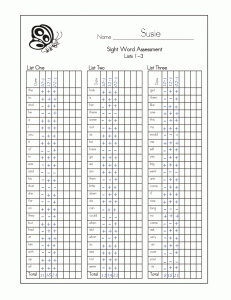
Assessing and Progress Monitoring Sight Words

One of the many benefits of my job is that I have the opportunity to travel to many different elementary buildings.  I know you may be sitting there thinking, “I’d hate that”, but it’s actually tons of fun.  Each building has it’s own unique personality so every day of the week brings a brand new experience.  When I first started my job traveling among the 13 elementary buildings in our ISD, it was plainly obvious that each building had it’s own measure of what they considered to be “normal”.  In fact, the idea of what was considered “normal” could (and often did) vary from teacher to teacher within the same building.  We were quite often faced with a situation where a teacher would bring a child

[Read More...]

Activities for Teaching the Magic e Rule

Learning vowels can be very challenging for our young readers and writers because they make different sounds in different words.  Vowels can either make a short sound such as the /a/ sound in the word “cap” or a long sound, such as the /a/ in the word “lake”.  When reading, children must decide whether the vowel in the word makes its short or long sound.  There are several ways to make a long vowel sound in words.  One way is to add the Magic e at the end of a word.  The Magic e usually changes the short vowel sound into a long vowel sound.  Teaching children this rule helps them to determine which sound the vowel will make. A simple

[Read More...]

Using Hand Signals to Teach Short Vowel Sounds

Two years ago I was noticing a pattern when I was working with first grade students.  I had groups of first graders who were very accurate with their short vowel sounds on the nonsense word fluency assessment of the DIBELS.   At times, these kiddos would quickly make motions while reading the CVC words.  The motions served as a cue to the correct pronunciation of the vowel sound.   I then did “sort of” an informal field study.  I determined which teachers were using hand signals to teach vowels and which ones were not.  I then compared student data and confirmed what I thought to be true.  When teachers use hand signals when teaching short vowel sounds, students are much more accurate when reading words.   It all makes sense.  I am a

[Read More...]

Response to Intervention: 8 Core Principles

 This coming school year will be our 9th year of our Response to Intervention (RtI) initiative. Honestly, the years have passed so quickly and it’s hard for me to remember how we used to function before RtI. Not that everything is perfect now by any means, but RtI has become such an integral part of our school culture that it seems almost natural. One of the reasons I started this blog was to share with you content information as well as our personal experiences we have had while traveling along our RtI journey. Implementing a RtI model does not happen overnight as I’m sure those of you who have started such an initiative can attest to. There are bumps and

[Read More...]

Phonological Awareness, Phonemic Awareness and Phonics

Several years back all the K-6 and special education teachers in our districts participated in the Language Essentials for Teachers of Language and Spelling (LETRS) training.  One of the beginning sessions introduced the the five key areas of reading instruction proposed by the National Reading Panel.  Phonemic awareness and phonics are two of these components.  During this session, there seemed to be quite a bit of confusion over the terms of “phonological awareness”, “phonemic awareness” and “phonics” and knowing the difference between those terms.   So, let me see if I can help provide clarification. Phonological Awareness- Phonological awareness is a general appreciation of how spoken language can be divided into its components.  For example, we speak in sentences.  Sentences can be broken

[Read More...]

Bead Slide: A Tool for Teaching Phoneme Segmentation

The bead slide is one of my favorite tools to use when teaching the phonemic awareness skill of phoneme segmentation.  They are so simple to make.  Check out the video to see how to use and make the bead slide.     Sometimes it’s just hard to come up with words right off the top of your head while you are working in your small groups.  Here is a little cheat sheet for you. Click the following link to download this handout.  Phoneme Segmentation Words Did you Know–Segmenting and blending are the two phonemic awareness skills found to have the greatest impact on learning to read. The Bead Slide is one of 15 hands on activities contained within the Response

[Read More...]

Why Students Reverse Letters

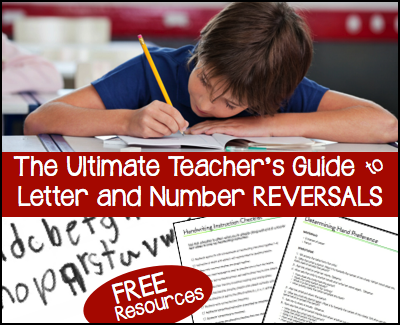
  Many parents become quite concerned when looking at their child’s writing and see that their child is confusing letters such as b/d, p/q or m/w.  Letter and word reversals have become so strongly associated with dyslexia that it’s no wonder why parents are anxious when they see such confusions.  As educators, it is important for us to understand why students reverse letters and to provide parents with the best information possible. Learning to Read Before we talk about reversals, let’s take a moment and think about what we are asking children to do when we are teaching them to read.  In our system, learning to read is based on the alphabetic principle.  This means that a child must understand

[Read More...]

Four Ways to Build Reading Fluency

I’m on spring break now and before leaving had to decide which book to pack for reading on the beach.  I came oh so close to purchasing the Hunger Games, but grabbed Timothy Rasinski’s book The Fluent Reader from our loaning library at work instead  (sad, I know).    I’ve read the book before and remember thinking it was filled with great strategies for improving reading fluency.  What I didn’t remember, however, was that the first chapter was devoted to an interesting account of the history of oral reading and silent reading in American education as well as pointing out the drawbacks of current practices such as round robin reading.   Here’s a snip-it of what I’ve read: It hasn’t been until

[Read More...]

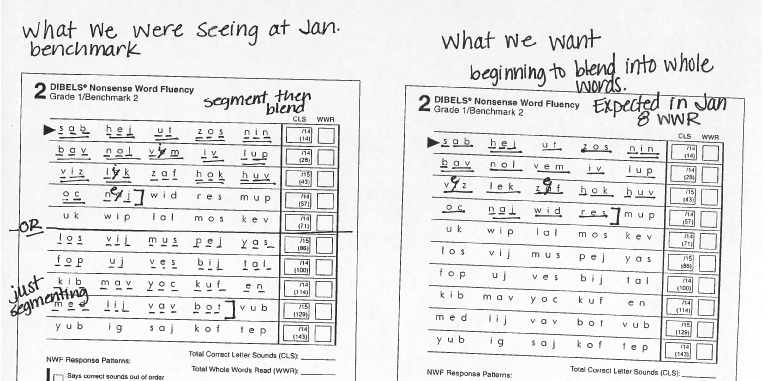
Helping Students Move to Blending Consonant-Vowel-Consonant Words

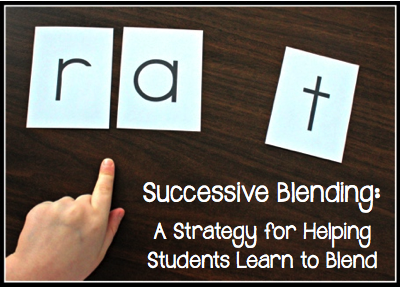
Our seven school districts changed from using the DIBELS 6th Edition to the DIBELS Next this school year.  Following each benchmark assessment we were just a little bit nervous (actually, really nervous) as to what our data would look like.  Would any changes we see be a result of the change in the assessment or as a result of a change in instruction?  When comparing our data using the DIBELS Next to our past assessment trends, one of the most striking differences came at the winter benchmark assessment for first grade.  Although we maintained the percentage of students performing at benchmark, we now had many more falling within the intensive range.  Yikes!  After analyzing all the data, our school teams felt that the new requirement

[Read More...]

Follow Us

Popular Posts