I was shopping at one of my favorite “go-to” stores for fun holiday manipulatives and found these adorable heart gems. It’s easy to make an activity a little more engaging by simply changing the materials. Changing the manipulatives for segmenting activities is super easy and the kiddos love it. Gems such as these hearts work great for holidays and you can always find them in the Dollar Tree for each season. Mini-erasers are fun too and you can find them for each holiday and sport.
These are the gems that I found in the holiday section at Walmart. You can use the pictured cards from the Squaring Up activity available in my TpT store if your students need the visuals.
Click HERE to download the Squaring Up activity from my TpT store.
For students who are a little more advanced, simply say a word and have them move a gem for each sound. Here’s a “cheat sheet” with 2-, 3- and 4- phoneme words that you can use during your small group instruction.
Click the following link to download the free cheat sheet Phoneme Segmentation Cheat Sheet
Have a Happy Valentine’s Day!
Two kids away at college and the other at a birthday party. What’s a mom to do? Go SHOPPING! No mall for me, though, just a quick jot over to the Dollar Tree and a stop at Walmart for wiggly eyes (super cool project for an upcoming post). While at the Dollar Tree, I found these adorable Frankenstein sippy cups. They were practically jumping off the shelf into my hands begging to be made into a project. So here’s what I came up with.
The activity is phoneme segmentation activity where students name the picture, segment the sounds (“ant” /a/ /n/ /t/) and place the picture in the correct cup with the number of sounds (2, 3, or 4). To make this activity you will need 3 sippy cups (if you can’t find Frankenstein, pumpkins will work fine too), 15 pipe cleaners (can use popsicle or large craft sticks) and your glue gun.
1. Print the following pdf on card stock and cut out the pictures.
Click the following link to download the pictures for this activity Phonemic Awareness Halloween Activity
2. Glue a number on the top of the plastic straw.
3. If you choose to use pipe cleaners, double-up the pipe cleaner 3/4 the way down. I only chose to use pipe cleaners because I had them on hand (and the colors matched). Craft sticks would work just as well.
4. Place glue on the top of the pipe cleaner and adhere the picture.
It’s always fun to put a holiday twist on your small group activities. I think the students are going to love this one!
Phonemic awareness- the ability to hear and manipulate the sounds in spoken words and the understanding that spoken words are made up of sequences of speech sounds (Yopp, 1992)
The best predictor of reading difficulty in kindergarten or first grade is the inability to segment words and syllabes into constituent sound units (Lyon, 1995)
The research is very clear on the important role phonemic awareness plays in the reading process. Children must understand that language is comprised of spoken words and that those words can be broken down into separate sounds. The child’s level of phonemic awareness upon entering school is one of the strongest indicators of how well he/she will learn to read. The exciting part is that, as teachers, by assessing our students’ phonemic awareness skills early on, we can identify those who may be at risk for reading difficulties and provide intervention right away. Research also indicates that phonemic awareness skills can be developed through instuction and that by doing so, the child’s reading and writing development improves.
Phoneme segmentation is one of the later developing skills on the hierarchy of development. By the six years of age 80%-90% of children can segment single syllabes with 2 or 3 sounds without blends (“cat”- /c/ /a/ /t/) and by 6 1/2 are able to segment 3-4+ phoneme words including blends (“black”- /b/ /l/ /a/ /k/). After you assess your students and identify those who need extra help with this skill, try some of the following activities.
1. Doggie Where’s My Bone. Although this activity is not technically a segmenting activity, I like to start with Doggie, Where’s My Bone so that the students begin to pay attention to individual sounds in words. With this activity, you will give the students a word and then a sound (“bug” /u/). Their job is to put the bone either on the head, body or tail to indicate the position of the sound. So simple, but the kiddos love it!
Download the Doggie, Where’s My Bone activity for FREE
2. Breaking Up Words. Another early phonemic awareness segmenting activity I like is the Breaking Up Words activity. This activity has a one-to-one correspondence with the dots on the card and the number of sounds in the word. Be sure to provide a lot of modeling and practice during this part of your intervention program. You can gradually decrease the amount of prompting you provide as the students improve.
Click HERE to download this activity.
Once the students are successful with the one-to-one correspondence activity and are pretty much independent with this, we can then increase the difficulty of the task by not providing the one-to-one correspondence component. Now the fun begins! You can alternate any one of these activities- so mix it up to keep it interesting.
3. Beads. A few months back I wrote a blog post and included a video on how to make and use the beads during intervention. Click HERE and you’ll be directed to that post. Here’s the gist– say a word and have your students move a bead for each sound in the word.
4. Push lights. Okay, not my original idea, but it’s brilliant. I wish I could have tracked down the person who thought of it. These are battery operated push lights originally intended for night lights. Simply push the button and the light turns on. You’ll need at least 4 lights. Have the student push the button (turn on the light) for each sound in a word. These lights can be purchased in most large department stores.
5. Balls. This is another quick and easy mix it up activity. Give each student a ball and have him/her toss the ball up in the air for each sound in the word. I just use the small foam balls that you can purchase at any dollar store.
6. Squaring Up. The Squaring Up activity is a really good activity for teaching segmentation. First place a plastic tile (you can use bingo chips if you wish) under each square and have the student say the word and move the a tile for each sound in the word while saying the sounds.
Click HERE to download this activity.
7. How Many Sounds? This activity is another favorite of mine. By writing the correct number of sounds on the back of each card, you can turn this into an independent learning activity for a center. You can use library pockets or labeled cups for this activity.
Click HERE to download step-by-step directions and 42 colorful pictures.
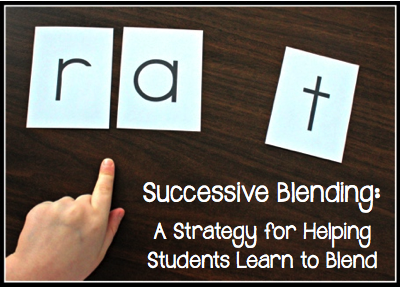
8. Race Car Blending. You can teach blending and segmenting together. This activity is an all-time favorite with the boys. Students use their cars and drive over the letters slowly while saying the sounds. They eventually speed up so that the word is blended at a normal speed. Just remember that the goal is to teach blending and not so much the letters/sounds. So, you’ll likely have to provide the sounds before beginning the activity.
Click HERE to download the Race Car activity.
Sometimes I just can’t come up with 2-, 3- and 4- phoneme words off the top of my head. I created this cheat sheet to help.
Click the following link to download the FREE pdf Phoneme Segmentation Words
Several years back all the K-6 and special education teachers in our districts participated in the Language Essentials for Teachers of Language and Spelling (LETRS) training. One of the beginning sessions introduced the the five key areas of reading instruction proposed by the National Reading Panel. Phonemic awareness and phonics are two of these components. During this session, there seemed to be quite a bit of confusion over the terms of “phonological awareness”, “phonemic awareness” and “phonics” and knowing the difference between those terms. So, let me see if I can help provide clarification.
Phonological Awareness- Phonological awareness is a general appreciation of how spoken language can be divided into its components. For example, we speak in sentences. Sentences can be broken down into words and words into syllables. Breaking words into onset-rime and an appreciation of rhyme and alliteration fall under the category of phonological awareness.
Phonemic Awareness- The word “phoneme” means sound. When a word is broken down into its smallest unit, a sound (or phoneme), the term “phonemic awareness” is used. Phonemic awareness is a sub skill of the broad category of phonological awareness. Phoneme isolation, blending, and segmenting are several skills that fall under this category.
Maybe this graphic helps.
Click the following link to download the above graphic: Phonological Awareness
Phonics and phonemic awareness are not the same. Phonics involves how speech sounds correspond to the written letter or letter combinations. Phonemic awareness is only about hearing and manipulating the individual speech sounds in words. The best way to remember the difference between these two terms is to know that any phonemic awareness skills can be “done in the dark”.
To download the “Do It In the Dark” poster click the following link: Phonemic Awareness Do It In the Dark
Did you know– Research has identified phonemic awareness and letter knowledge as the two best predictors of how well a child will learn to read during the first two years of school.
The bead slide is one of my favorite tools to use when teaching the phonemic awareness skill of phoneme segmentation. They are so simple to make. Check out the video to see how to use and make the bead slide.
Sometimes it’s just hard to come up with words right off the top of your head while you are working in your small groups. Here is a little cheat sheet for you.
Click the following link to download this handout. Phoneme Segmentation Words
Did you Know–Segmenting and blending are the two phonemic awareness skills found to have the greatest impact on learning to read.
I can hardly walk through the seasonal section of any store lately without filling my cart with fun items to make games! My newest and greatest fun find are these cute little candy filled cupcakes I found at Walmart. They are really meant for filling Easter baskets, but will absolutely make the best ever memory game. There are a total of 28 little plastic cupcakes. Simply print the page on a full size label (Avery 48165), cut out the little rhyming stickers and place them on the bottom of the cupcakes. Your students will love this new twist on a favorite game.
Click on the following link to download your free stickers for the cupcakes. Cupcake Rhyme Memory Game
Okay, as I am learning not all the Walmart stores carry the same items. So, if you cannot find the cute little plastic cupcakes, I have included printed memory cards. Print the stickers above and place them on the back of the cards. Click the following link for printed cupcakes. Cupcake Rhyming Cards
I’ve also heard that Target carries many of the same Easter items, so if can’t find the cupcakes at your local Walmart head on over to Target.